
Hydro Cyclone
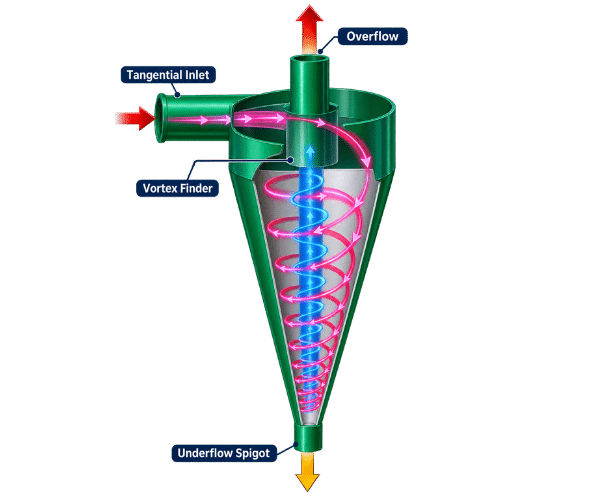
A hydrocyclone is a static separation device with no moving parts that utilizes fluid pressure to classify or separate particles within a liquid slurry. The process begins when slurry is pumped tangentially at high velocity into the cylindrical upper section, creating a powerful primary vortex.
| Model | Diameter (mm) | Height (mm) | Feeding Pressure (Mpa) | Separation Size (μm) | Weight (kg) |
|---|---|---|---|---|---|
| BMPE-HC-75 | 75 | 472.5 | 0.1-0.5 | 20-60 | 4 |
| BMPE-HC-100 | 100 | 499 | 0.05-0.4 | 20-60 | 8 |
| BMPE-HC-125 | 125 | 590 | 0.05-0.4 | 25-65 | 10 |
| BMPE-HC-150 | 150 | 786 | 0.05-0.4 | 30-75 | 22 |
| BMPE-HC-200 | 200 | 1114 | 0.05-0.4 | 40-100 | 36 |
| BMPE-HC-250 | 250 | 1380 | 0.05-0.4 | 40-100 | 63 |
| BMPE-HC-300 | 300 | 1490 | 0.03-0.4 | 50-150 | 88 |
| BMPE-HC-350 | 350 | 1674 | 0.03-0.4 | 50-150 | 135 |
| BMPE-HC-500 | 500 | 2280 | 0.03-0.4 | 74-200 | 416 |
| BMPE-HC-660 | 660 | 2720 | 0.03-0.4 | 74-200 | 950 |
The immense centrifugal force generated by this vortex throws heavier, denser, or coarser particles toward the inner wall. These solids spiral down the conical section and discharge through a narrow opening at the bottom, known as the apex, forming a concentrated stream called the underflow. Meanwhile, a low-pressure core in the center of the cyclone causes most of the liquid and the lighter, finer particles to reverse direction, forming an inner vortex. This secondary vortex travels upward and exits through a central pipe at the top, the vortex finder, as a more dilute stream known as the overflow. This elegant and efficient design makes the hydrocyclone an indispensable tool for separation and classification in industries such as mining, oil and gas, and wastewater treatment due to its simplicity, low cost, and high throughput.
Get a Quick Quote
Tell us what you need, and our team will get back to you shortly.