
Paddle Mixer
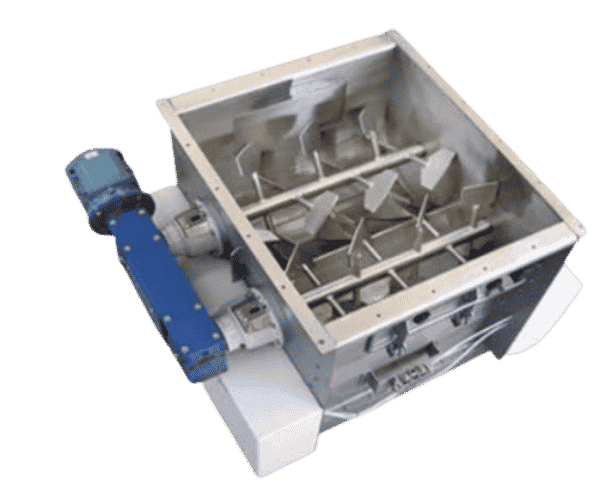
Paddle Blender, Paddle Mixer Optimum mixing achieved by fluidization by combination of defined geometry lifting action with multi zoned, triple paddle stirrer rotor turning about 80 % faster than other mixer and Ribbon blender.
Agitator Design – Mix & Match to Suit Your Application!
During mixing process fluidization assures homogeneous mixes independent of large range of particle size, shape or density in 30 to 60 second time. The paddles are positioned to move the material in opposing lateral directions as well as radically. The mixer consists of a rigid fabricated structure motor, gear box, mixing U-shaped horizontal drum and peddle type stirrer
Salient Features:
- Design is cGMP – Current Good Manufacturing Practices compliance.
- All contact parts AISI 316 & non-contact parts AISI 304.
- High mixing technology provides the ideal environment for effectively mixing a wide distribution of particle size and bulk densities without segregation.
Available in Capacity 50 KG to 4000 KG. model
manufacturing Paddle Blenders, Paddle Ribbon Blenders, and Ribbon/Ribbon Blenders for a wide variety of mixing applications including feed and grain, non-directional liquid or slurry mixes, soap pellets, particulates, abrasive products, pastes, filter cakes, and fragile/friable products.
Paddle Blenders: Efficient and Gentle Mixing Solutions
Paddle blenders are widely used in various industries for blending powders, granules, and even some semi-solids. Their simple design and effective performance make them suitable for a wide range of applications, particularly where delicate or heat-sensitive materials need to be mixed gently and efficiently. Here’s an in-depth look at how paddle blenders operate, their key features, and the advantages they offer over other mixing technologies.
Key Design Features of Paddle Blenders:
1. U-Shaped Horizontal Trough:
- Paddle blenders typically feature a U-shaped trough, which provides a well-designed space for material movement during the blending process. This shape ensures that material flows efficiently through the system, optimizing the mixing cycle.
2. Solid Agitator Shaft with Paddle Blades:
- The agitator shaft is mounted with paddle blades that rotate within the trough. These paddles are strategically positioned to generate both radial and axial motion.
- Radial Motion: The paddles move material outward, promoting even distribution and preventing material build-up in any one area.
- Axial Motion: The paddles also move material along the length of the trough, ensuring a thorough, consistent mixing throughout the entire batch.
3. Paddle Pitch and Design:
- The paddles are precisely pitched to optimize the movement of the material. The pitch is designed to move material in opposite directions (radially and axially), ensuring that the material is mixed gently and uniformly without causing excessive friction or compression.
- Unlike other mixer designs (e.g., ribbon blenders), paddle blenders have less surface area at the periphery, which results in a gentler blending action.
Advantages of Paddle Blenders:
1. Gentler Blending Action:
- One of the key benefits of paddle blenders is their gentle mixing action. This is due to the paddle design, which avoids the sharp pinch points near the vessel walls commonly seen in ribbon blenders.
- The reduced surface area at the periphery of the paddle minimizes material compression and reduces the likelihood of delicate products being damaged during mixing.
2. Reduced Heat Generation:
- Paddle blenders generate less heat compared to other mixing technologies, such as ribbon blenders or high-speed blenders. This is particularly beneficial when handling heat-sensitive materials, as excessive friction or shear forces can degrade or alter the properties of certain products.
3. Consistent Mixing with Less Material Degradation:
- The design of the paddles ensures that the materials are mixed thoroughly without excessive shear, reducing the risk of product degradation or material breakdown, which could be a concern when blending fragile ingredients like herbs, spices, or light powders.
4. Flexibility for Various Material Types:
- Paddle blenders can handle a wide variety of material characteristics, from dry powders to granules and even some pastes. The gentle, yet effective, mixing action makes them suitable for industries such as pharmaceuticals, food processing, chemicals, and cosmetics.
5. No Pinch Points:
- As mentioned, paddle blenders avoid pinch points, which are a common feature in ribbon agitators. Pinch points can cause delicate products to be squeezed or compressed, altering the texture or form of the material. This makes paddle blenders more suitable for fragile, friable, or granular products that need careful handling.
6. Easy Cleaning and Maintenance:
- Due to the simple and robust design, paddle blenders are typically easy to clean and maintain. The paddle shafts and trough are usually designed to be easily accessible, allowing for efficient maintenance and sanitation procedures, which is critical in industries like food and pharmaceuticals.
7. Versatility in Batch Sizes:
- Paddle blenders are available in various sizes and can be adapted to suit different batch capacities. Whether you’re working with small batches for research and development or large-scale industrial production, paddle blenders can be tailored to your specific needs.
Common Applications of Paddle Blenders:
1. Powder Blending:
- Paddle blenders are commonly used for blending dry powders in various industries. The gentle motion ensures that different powders are evenly mixed without causing separation or clumping.
- Applications include the blending of ingredients for pharmaceutical formulations, baking powders, animal feed, and chemical powders.
2. Granule Mixing:
- These mixers can also handle the mixing of granules for products such as fertilizers, detergents, and cosmetic products. The paddles’ gentle action ensures that granules are evenly distributed without causing breakage.
3. Sludge and Waste Conditioning:
- Paddle blenders are effective in the conditioning of sludges, ash, and other waste products, especially when there is a need for adding moisture or chemicals to facilitate further processing or stabilization.
4. Food Processing:
- In the food industry, paddle blenders are used to mix various ingredients, such as spices, flour, sugar, and dried fruit, without damaging or altering the texture of the products.
- They are also useful for products like instant mixes, where the delicate balance of ingredients must be maintained to preserve product quality.
5. Pharmaceutical Applications:
- The gentle mixing action makes paddle blenders ideal for blending ingredients used in the pharmaceutical industry, where the integrity of sensitive materials such as powdered medications or herbal products must be preserved.
6. Cosmetics and Personal Care:
- Cosmetic formulations such as creams, lotions, and powders benefit from the gentle and consistent mixing provided by paddle blenders, ensuring uniformity and product integrity.
Get a Quick Quote
Tell us what you need, and our team will get back to you shortly.