
Linear Motion Vibrating Screen
As a leading linear vibrating screen manufacturer, BMPE specializes in delivering highly customized screening solutions tailored to diverse materials, industries, and production environments. Backed by more than 20 years of manufacturing expertise, we provide professional customization services that ensure our linear vibrating screens operate with maximum efficiency, reliability, and precision to meet your specific processing needs.
Below is a complete overview of our customization capabilities.
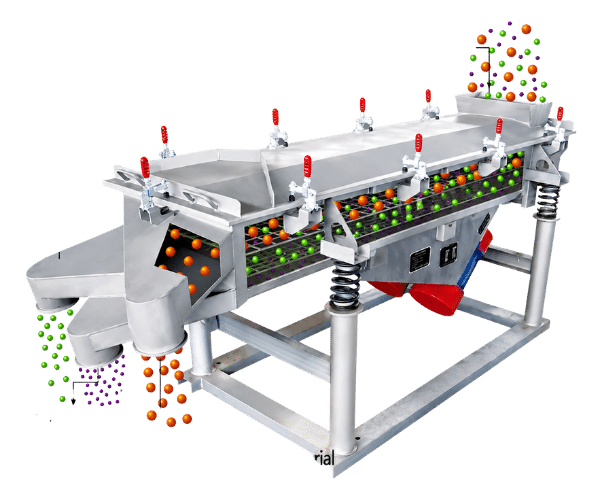
Linear vibrating screen, also known as a linear motion vibrating screen, has a linear motion and is used for screening, classifying, deblocking, and dewatering lumpy solids or slurries. It uses a vibrating motor to throw materials upward and forward in a linear motion. These models are usually equipped with dual vibration motors that operate in synchrony. Centrifugal force and gravity help throw the material in the direction of movement. Multi-layer systems can separate the product into 2–7 different parts, while multi-stage separation is completed by removing impurities.
Linear vibrating screens can provide a screening area from 500 mm to 1,500 mm wide and 1,500 mm to 4,000 mm long, allowing up to 20 tons/hour of processing capacity. They are suitable for a variety of dry materials with a particle size of 0.074–5 mm and a moisture content of less than 70%. For screening powdery, non-sticky materials, the maximum feeding particle size should not exceed 10 mm.
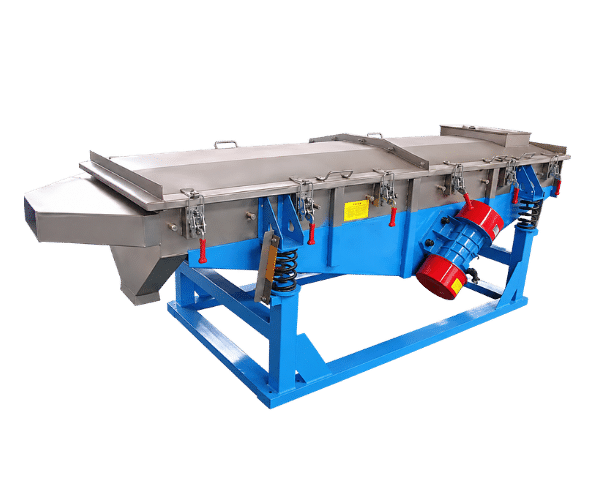
The linear vibrating screen relies on two reverse motors of the same frequency to make the material move straight forward on the screen surface. After a large number of broken materials with different particle sizes and mixed thicknesses enter the screen surface, only a portion of the particles come into contact with the screen surface. The vibration of the box loosens the material layer on the sieve, which further expands the existing gaps between the large particles, allowing the small particles to pass through the gaps and move to the lower layer. Due to the small gaps between the small particles, the large particles cannot pass through. Thus, the originally disordered particle groups are separated, that is, stratified according to particle size, forming an arrangement in which the small particles are at the bottom and the coarse particles are at the top, thereby achieving the purpose of screening and sorting materials.
| Model | Screen Size (mm) | Power (kW) | Vibrate RPM | Amplitude (mm) | Size (L × W × H, mm) | Weight (kg) |
|---|---|---|---|---|---|---|
| BMPE 50 × 100 | 500 × 1000 | 0.25–2 | 960 | 4 to 6 | 1200 × 750 × 1100 | 300 |
| BMPE 50 × 200 | 500 × 2000 | 0.55–2 | 960 | 4 to 6 | 2200 × 750 × 1100 | 400 |
| BMPE 80 × 200 | 800 × 2000 | 0.75–2 | 960 | 4 to 6 | 2200 × 1050 × 1100 | 600 |
| BMPE 100 × 200 | 1000 × 2000 | 0.75–2 | 960 | 4 to 6 | 2200 × 1250 × 1200 | 900 |
| BMPE 120 × 250 | 1290 × 2500 | 1.1–2 | 960 | 4 to 6 | 2700 × 1450 × 1200 | 1400 |
| BMPE 150 × 300 | 1500 × 3000 | 1.5–2 | 960 | 4 to 6 | 3200 × 1750 × 1200 | 1600 |
Get a Quick Quote
Tell us what you need, and our team will get back to you shortly.