
Shredder
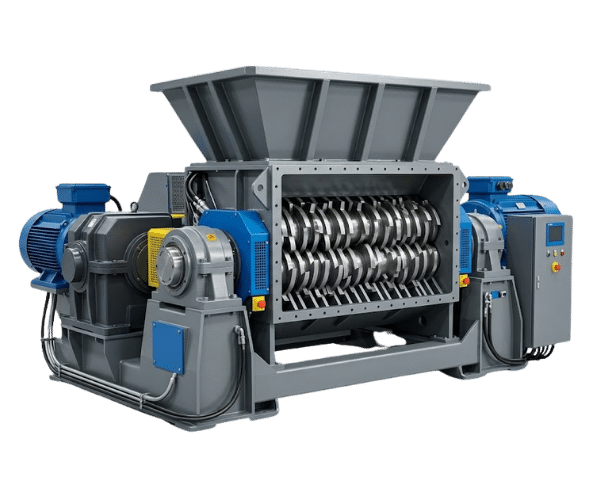
I. Working Principle
BMPE twin-shaft shredders mainly consist of two counter-rotating shafts, on which specially designed shredding blades are mounted. When materials enter the shredder chamber, as the shafts rotate at high speed, the blades interlace and shear, exerting strong tearing and squeezing forces on the materials. Whether it’s tough metal products, flexible plastics and rubbers, or bulky woods and textiles, they can be quickly broken down into evenly sized small pieces under this force, laying a solid foundation for subsequent processes such as sorting and reprocessing in resource utilization.
II. Structural Features
Robust Body
The main body of the equipment is welded with high-quality steel plates and undergoes stress relief treatment and overall machining. This process ensures the stability of the equipment during long-term heavy-duty operation, enabling it to withstand high-intensity working pressure and extend its service life.
High-Quality Blades
Rotating Blades: The rotating blades are made from special alloy tool steel forgings. Through precise machining, multiple heat treatments, and cryogenic freezing heat treatment technology, the overall toughness and hardness are consistent, allowing for repeated repair and reuse, which greatly ensures cutting performance and service life.
Fixed Blades: The fixed blades adopt a unique hook-type installation, which optimizes the blade replacement function, making blade maintenance and replacement more efficient and convenient.
The hexagonal shaft and its unique design make the disassembly, assembly, and replacement of cutting tools more convenient.
Convenient Maintenance Bearing Housing
The bearing housing features a split and detachable design, enabling quick removal of the rotating blades, fixed blades, bearings, and other components, which is convenient for daily maintenance and blade replacement. Meanwhile, its unique sealing structure effectively isolates the contact between crushed materials and grease. Even when processing liquid materials, it can well protect key components such as bearings and gears.
High-Strength Shafts
The shafts are manufactured from high-strength, heavy-duty special steel and are reasonably matched with the blades, providing strong power support for the cutting process and ensuring the efficient operation of the equipment.
III. Applicable Materials
1. Plastics
It can easily shred various plastic beverage cans, plastic buckets, plastic baskets, plastic pallets, as well as waste plastic pipes, fittings, PE pipes, etc.
2. Metals
It can effectively process materials such as car shells, aluminum alloy die-castings, metal parts of old household appliances, light metal scraps, iron filings, aluminum cans, and paint buckets, regardless of whether the materials are hard or soft.
3. Wood
It can crush waste formwork, wooden pallets, forklift pallets, branches, tree trunks, and other wood materials into suitable sizes for subsequent processing and utilization.
4. E-Waste
Through the processing of our twin-shaft shredders, old hard drives, PCB boards, keyboards, mice, mobile phones, CD discs, and other electronic waste are conducive to the subsequent recovery of precious metals and other resources.
5. Others
It can also process a wide range of materials, including kitchen waste, domestic waste, animal carcasses, RDF derivatives, medical waste, biomass straws, garden waste, rubber head materials, paper mill ropes, etc., with an extremely extensive application range.
IV. Performance Advantages
Powerful Crushing Ability
The high-torque design enables it to easily handle large-sized, thick-walled, hard, and highly entangled materials, which is unmatched by single-shaft shredders. For example, it demonstrates excellent crushing performance when processing scrapped car shells and large bundles of plastics.
High Adaptability and Versatility
By replacing blades and screens (optional) with different shapes and spacings, the output size can be flexibly adjusted to meet the crushing requirements of various materials. Whether you need to crush materials into larger pieces or smaller particles, it can meet your needs.
Controllable and Uniform Output Size
The output size is mainly determined by the blade gap. With the cooperation of the screen, more uniform pieces can be obtained, which is convenient for subsequent sorting, recycling, or processing. This feature gives our twin-shaft shredders obvious advantages in the resource recycling industry.
Stable and Reliable Operation
With a solid overall structure and high design redundancy, it is suitable for continuous production under various harsh working conditions. Even with long-term uninterrupted operation, it can maintain a stable operating state, reducing downtime caused by equipment failures and improving production efficiency.
Relatively Easy Maintenance
Blades can usually be replaced individually, and some designs allow blade replacement without disassembling the shaft. Meanwhile, some models are equipped with a hydraulic cover-opening design, which greatly simplifies maintenance work and reduces maintenance costs and difficulties.
High Processing Efficiency
The twin-shaft design provides a larger effective working area and stronger tearing force, resulting in a high processing capacity per unit time. Compared with traditional crushing equipment, it can complete the crushing of a large amount of material in a shorter time, improving the production efficiency of enterprises.
V. Application Areas
Urban Domestic Waste Treatment
It can effectively process various wastes in domestic waste, crushing and reducing their volume, which is convenient for subsequent landfill, incineration, or resource utilization.
Resource Recycling Industry
It helps with the recycling and reuse of waste metals, plastics, wood, etc. Through shredding, it provides suitable raw materials for subsequent processing processes such as smelting and granulation.
Industrial Waste Treatment
It processes scraps and waste generated during industrial production, helping enterprises achieve green production, reducing raw material procurement costs, and simultaneously reducing the environmental pressure of industrial waste.
Construction Industry
It can effectively shred and separate concrete blocks, bricks, steel bars, etc. in construction waste from demolition, improving the resource utilization rate of construction waste and promoting the development of a circular economy in the construction industry.
Agricultural Field
It can initially process biomass wastes such as straws and agricultural films, providing convenience for the production of organic fertilizers, biofuels, etc., and promoting the harmless and resource utilization of agricultural wastes.
Get a Quick Quote
Tell us what you need, and our team will get back to you shortly.